The following explains the origin of the fluid and matrix parameters listed above. Project examples for this are, for instance, geothermal extraction and reinjection systems or thermally used ground probe fields. As a rule, an investigation is first carried out, for example using a GeoResponse test, to determine the suitability of the subsurface for geothermal use. The fluid parameters set above are empirical values from the literature. The following figure shows the results of a project-specific subsurface investigation.
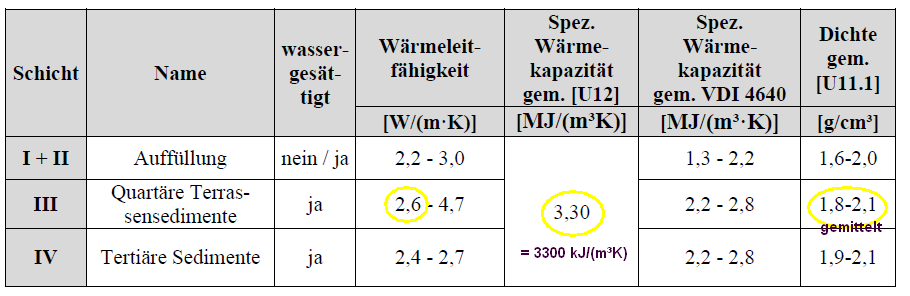
Origin of the heat parameters
The matrix density ρs of 1,900 kg/m³ used in the SPRING dialog was taken as the average of the measured density of the Quaternary terrace sediments. The thermal conductivity of the matrix ʎs is calculated from the thermal conductivity of the overall system (ʎtotal from the table = 2.6 for Quaternary terrace sediments) using the following formula:
ʎf * n + (1-n)*ʎs = ʎtotal
ʎf = 0,6 W/(m*K), Empirical values fluid (groundwater)
n = Porosiy (of the model) [-]
ʎs = Thermal conductivity of the matrix , is wanted
ʎtotal = 2,6 W/(m*K), from figure above
With a porosity of 0.07 and rearranging the equation for ʎs, we get ʎs = 2.75 W/(m*K). The heat capacity cs is calculated from the determined specific heat capacity (from the table) of 3,300 kJ/(m³*K) by dividing by the matrix density ρs of 1,900 kg/m³, resulting in 1,737 J/(kg*K). The conversion from kJ to J must be observed. The parameters for the other soil layers can be assigned via a zoning file.
 Freezing
Stand: 21.04.2026 | 